 Nidae Kashmir
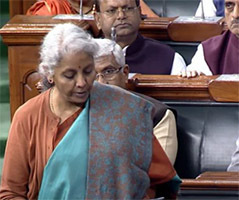
Finance Minister Nirmala Sitharaman on Tuesday tabled the Economic Survey 2022-23 in Parliament.
Following are the highlights of the Economic Survey 2022-23 tabled in Parliament on Tuesday:
> India’s economy to grow 6.5 per cent in 2023-24, compared to 7 per cent this fiscal and 8.7 per cent in 2021-22
> India to remain the fastest growing major economy in the world
> GDP in nominal terms to be 11 per cent in next fiscal
> Growth driven by private consumption, higher capex, strengthening corporate balance sheet, credit growth to small businesses and return of migrant workers to cities
> India third largest economy in PPP (purchasing power parity) terms, fifth largest in terms of exchange rate
> Economy has nearly “recouped” what was lost, “renewed” what had paused, and “renerengised” what had slowed during the pandemic and since the conflict in Europe
> Real GDP growth to be in the range of 6-6.8 per cent next fiscal depending on global economic, political developments
> India’s recovery from the pandemic was relatively quick, growth next fiscal to be supported by solid domestic demand, pick up in capital investment
> RBI projection of 6.8 per cent inflation this fiscal outside the upper target limit, not high enough to deter private consumption, also not too low to weaken inducement to invest
> Borrowing cost may remain ‘higher for longer’, entrenched inflation may prolong tightening cycle
> Challenge to rupee depreciation persists with the likelihood of further interest rate hikes by the US Fed
> CAD may continue to widen as global commodity prices remain elevated, economic growth momentum stays strong
> If CAD widens further, rupee may come under depreciation pressure
> Overall external situation to remain manageable
> India has sufficient forex reserves to finance CAD and intervene in forex market to manage rupee volatility
> Elevated downside risks to global economic outlook as inflation persisting in advanced economies and hints of further rate hikes by central banks
> Inflation did not “creep too far above” tolerance range compared to several advanced nations
> The growth in exports has moderated in second half of current fiscal; the surge in growth rate in 2021-22 and first half of current fiscal led to production processes shifting gears from ‘mild acceleration’ to ‘cruise mode’
> Slowing world growth, shrinking global trade led to loss of export stimulus in the second half of current year
> Schemes like PM KISAN, PM Garib Kalyan Yojana significantly contributed to lessening impoverishment
> Credit disbursal, capital investment cycle, expansion of public digital platform and schemes like PLI, National Logitics Policy and PM Gati Shakti to drive economic growth
> Bank credit growth likely to be brisk in FY24 on back of benign inflation, moderate credit cost
> Credit growth to small businesses remarkably high at over 30.5 pc in January-November, 2022
> Housing prices firming up after release of pent-up demand, decline in inventories
> Central govt capex grew 63.4 per cent in April-November of current fiscal
> India’s economic resilience has helped it withstand the challenge of mitigating external imbalances caused by the Russia-Ukraine conflict without losing growth momentum
> Stock market gave positive retruns in calendar year 2022 unfazed by FPI withdrawal
> India withstood extraordinary set of challenges better than most economies
> After a dip in FY21, GST paid by small businesses has been rising and now crossed pre-pandemic levels reflecting the effectiveness of targeted government intervention
> Private consumption, capital formation led economic growth in current fiscal has helped generate employment; urban employment rate declined, while Employee Provident Fund registration rose.